Wednesday, January 30, 2013

Home is... By Shannon Lough.


I’ve called many places my home. A two-story home in a small-town subdivision; a single flat for staff housing sandwiched between a petrol station and bar in a glacier tourist town; a trailer adjacent a raging river, and within the facilities of a popular backpacker hostel; a holiday-home in a popular extreme sports tourist town, at the base of mountain; a tent, in my hobo days; the first story of a duplex; an ex-communist student dorm; a tatami-floored Japanese apartment in a mountain village between Fuji-san and Tokyo; and recently, at the Yogi-Nomad’s home in Kathmandu valley full of budding yogis. I use my grandfather’s expression, that “home is where you hang your hat.” It could be in the back of a car, a beach along the Sea of Japan, or a 200Rs monsoon-sodden bed. But is this home? 

A forest dweller's home
Home is a concept that many of us get attached to. It’s a place where you store your stuff, and your memories. It gives one a sense of security, that after the day there is a place where you belong. A place where loved ones can greet you. A place where you can unwind and feel protected from the world out there. This is the tangible ‘home’ that many people associate with. 

This material place called home also becomes a nest of insecurities, as all attachments do. It’s full of possessions. Expensive or invaluable items that for years have been collected and arranged in your space, and create your sense of identity. With attachment comes fear, that you may lose one of these items, or someone may steal them, or the house could burn down. But you go on vacation and pick up another souvenir that will look great on your shelf, so when people come to visit they think how amazing your life is, and how beautiful your collections are. The ego stays ever present, and grows with each new piece of clothing, or decoration in your home. You build and build this material world around you and call it home. Until, you have to move. 

Nepali homes
Last year, one night I was sitting in meditation, I realized that my time in Japan was coming to an end in less than six months. I had too much stuff. I tried to find my concentration, and I ended up with stress about how I was going to take my snowboard with me. Where could I send it, if I didn’t know where I was going to be? I filled my head with worries over all that winter clothing, jackets and my closets packed with more clothing. Then I realized that I was stressed about stuff that had defined me somehow. I was a snowboarder. I was a hiker. I was teacher. Yet, I knew I had to let it go. I couldn’t admit it to myself. A special person said to me, “remember that a tool is only good when you are in need of it, if you carry it unnecessarily with you all over it will become a burden and keep you attached to this world.” I knew that he was right, and I was set on letting go of my attachments. I sold or gave away all my gear and clothing. Steadily, the burden lifted, and I felt freer. 

It is a process. I traveled to India and Nepal with a 60L backpack, that I crammed till it bulged and spilled out from the top. I had given up my so-called sense of security by ending my contract, leaving my apartment, and sending half my things to Canada, half to Thailand. I had minimized my home to a backpack, which I still managed to overburden myself with. I felt awkward every time I left a new place, and had to swing it precariously up over my shoulders, and waddle to the bus stop, or shove it into an auto-rickshaw. I met a guy who was traveling the boundaries of India with only a school-sized backpack. He inspired me. He was so light, and carefree. He probably only had one outfit, and a few accessories to change up his style from daytime to nighttime outings, like a scarf or a hat. He didn’t have a lot to worry about, and he seemed happier because of it. While I sweat, and toiled with my pack, he strolled effortlessly as we both walked the streets of Dharamkot looking for accommodation after we left the Tushita meditation centre. Again, I had to rethink the concept of home. 
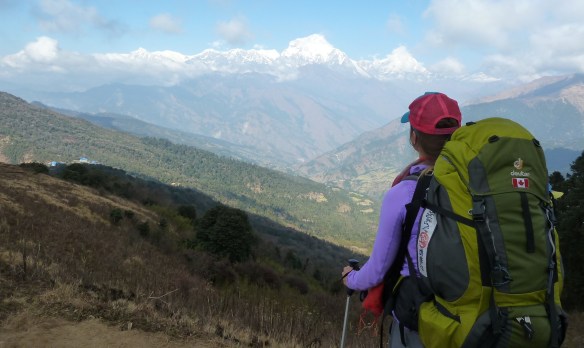
My backpack home

While we had been in the ten day Tibetan Buddhist retreat, we watched The Nature of Mind the teachings of Tenzin Palmo, a female monk who had spent twelve years living in a cave up in the Himalayas. Whatever she had discovered while living in the ten by six-foot cave, was apparent in the spark in her eyes and the command of her words. I wrote in my notes in brackets “(blowing my mind)” because she did. She said: “the mind is our true home, but we don’t clean it, get rid of the junk, exercise it, or air it out” I had never considered my mind as my home before. As a wanderer, a global nomad, I had always considered my home to be the place where I hung my hat, not inside the place where I wore my hat. 
Once you realize that your home, your true home, is your own mind, then you begin to feel a sense of relief. Everything that you need is right here. We are capable of complete happiness, if we know that we already have that light inside of us. Once we embrace that concept, then we let go of our fears of losing the external home. Whether you’re crawling into a sleeping bag, in a one-man tent, under a starry sky, or you’re nuzzling next to your partner in a king-sized bed, in a prefabricated home in the suburbs, you take that moment for what it is and enjoy it fully, without the worry of losing it tomorrow. 

My school-sized backpack friend told me to read Jon Kabat-Zinn, a Professor and author of discovering mindfulness in the West. While I was trekking in the Annapurna region, I read his book Wherever You Go, There You Are. I found nuggets of wisdom throughout the text. Especially in his concept of home. Let me share with you what I discovered during intimate moments of reading in the freezing cold guesthouses that I stayed at along the route.
So why not let go and admit that you might as well be at home wherever you are? Right in that moment, you touch the core of your being and invite mindfulness to enter and heal. If you understand this, then and only then will the cave, the monastery, the beach, the retreat center, offer up their true richness to you. But so will all other moments and places.

Somehow, through all the places I’ve called home in my past, I have arrived back in the place that I called home while I was growing up. From childhood to young adulthood, I was in this place that I had so many different emotions and feelings in. I have felt a welcoming, a familial love, warmth, protection, but also dread, disappointment, the feeling of being trapped and lost. How can one place harbour all these opposing emotions? The answer is that it was never my childhood home, the tangible one in a small suburban country town that fostered these forces, it was my mind. I am capable of creating all these conundrums. But I am also capable of contentment, of finding that place of acceptance and awareness in the present moment, and to embrace it fully. 


On a January day, in the beauty of the snow melting under heavy rain, birds seem unaware 
of the elements as they perch on a feeder, and children play outside in the slush with rubber 
Yogi home
boots under soggy snow pants. We have the power to chose how we see the world. I now clean my home daily. I give it a time to unwind, to rest. I guide it towards those I love, those I don’t, and those I don’t know. I send my compassion to them all. This morning I did a guided meditation with Yin yoga guru, Bernie Clark. He finished off the session with: “Breathing in, breathing out. Right here, right now, I am alive, I am breathing, I am home.”


Take a moment, and consider, where is your home?


Shannon Lough is a 200RYT, who completed her yoga and Thai massage training with Yogi-Nomad in Nepal.  She practices daily, and follows the principles of Tibetan and Zen Buddhism, after traveling to India and living in Japan for three years.  She is a marathon runner, a hardy backpacker, and an avid writer.  If you have any questions or comments please email her at s.a.lough@gmail.com 

Monday, January 21, 2013

Traditional Yoga Can Be Found in the Simplest of Intentions. By Shannon Lough.

Full Moon over the Himalayas

            Paying respect to traditions gives us a sense of our roots, our heritage and a sense of being.  We follow tradition because for centuries our ancestors have followed the ways that encapsulate the meaning of life and how to be free of suffering caused by uncertainty and trudging down dark paths.  But tradition has many faces.  It doesn’t always capture the best of us.  There are those who cling to traditions and refuse change, while there are those who fear traditions that are unfamiliar from their own.  With the world being increasingly cross-cultural, traditions of all sorts are being exposed to many reaches of the earth.  In their travel they are becoming transformed.  Through their transformation, we have to find a bridge that allows for us to protect the integrity of the tradition within the roots of their purpose.
            Yoga is one of these traditions.  It’s origins are rooted in the soils of the Indus Valley, beneath the Himalayan Mountains, what is Northern India and Pakistan today.  It’s traditions so ancient, that it’s claimed to have been practiced since the beginning of civilization.  Through internationalism, the seeds of yoga have scattered, blown in the wind and spread to those who seek light.  Yoga now touches upon the lives of people all over the world. 
            Yet the traditions of yoga have altered, significantly, in their travels from South Asia.  In the West, people flock to 40.6 degree Celsius rooms, to sweat it out in a session of Bikram’s hot yoga, or work their core in power vinyasa yoga classes that focus on asanas, or physical postures of yoga combined with fitness.  The roots of yoga, the mantras, the Om, breathing techniques, pranayama, and the intentions of finding inner peace, and stilling the mind to single-pointed concentration in meditation are foregone in the mist of vanity to achieve one’s ideal body type. 
Vishnu on his vehicle Garuda
            When the tradition has diverted so far from it’s roots, then what do you call it’s modern variation?  Is it time for the traditions to shift with the modern currents? 
            If you travel to the Himalayan regions of India or Nepal and take a yoga class, you will experience how the traditions have modernized in it’s birthplace.  Classes are conducted with an opening mantra, an Om, and an intention.  Then proceeded by a series of asanas, or poses, followed by a lengthy savasana.  Sometimes the class begins or concludes with pranayama, breathing exercises, and then a final meditation to use the benefits of the physical practice in stilling the body to ease into the mental practice.  The local yoga instructors have been practicing as a part of their culture, their heritage.  They probably woke up at 3 or 4am to do their own practice before the sun rose, and established their own equilibrium before teaching the class that you participate in for 500Rs.  Your class isn’t glistening with brand names, like Lululemon or prAna.  It’s simple.  You might even find yourself on a rooftop, with the monsoon pounding it’s way in through the makeshift roof made of tarpaulin, spraying you occasionally with rain as you press into adho mukha svanasana, or downward facing dog.  But you feel the wind on your face, and outside is a sea of green fields. 
            In the West, the yogic experience differs depending on where you practice and who you practice with.  Classes are more focused on the anatomy, which is safer than in India where you’ll be put into headstands and shoulder stands without caution.  Sometimes there are real gems out there, where you get the mix of modern Western and classical Eastern traditions.  The class will begin with a centering, focus on the breath, an Om you can join into, a sequence of poses that gets your heart pumping while simultaneously bringing you into yourself and connecting to the core of your being.  Then a calming savasana, and a final centering that reflects on the intentions of the class.  These classes exist.  The music played during class may not be a traditional method, but traditions can change, as long as the intention remains. 
            The next time you step into a yoga class, be mindful.  Leave your ego at the door, and explore yourself in the ancient tradition of connecting the body and mind.  Be aware of the poses that open up that connection, and go inward.  The hand foot bond to the mat should be all that matters, not the mirror in the room, or the person next to you.  Let go and chant Om, there’s a reason it’s called the eternal sound.  Lose yourself in the history of movement and discover how it makes you feel.  You will never know until you try.  Yoga is a tradition of self-discovery through seeking this connection.
            The origins of yoga comes from Sanskrit, to yoke, or union.  This is the intention of the practice.  It can be done through chanting, breathing, meditating, or physical movement.  Whatever form of yoga you practice, if your intention is to create a union of the body and mind with the true nature of yourself, then you are following the roots of the yoga tradition.  It doesn’t matter if you use modern music to carry you through your practice, if you laugh, sweat and shake, call the poses by their Sanskrit, or locally invented name, if your intention is pure then you are amongst the traditions of yoga.  Find your path and allow yoga to become your teacher as you explore its roots, and find a tradition that remains alive and intact in each of us. 

By Yoga, Yoga must be known;
Through Yoga, Yoga advances;
He who cares for Yoga,
In Yoga rests forever. 
(Unknown)


Shannon Lough is a 200RYT, who completed her yoga and Thai massage training with Yogi-Nomad in Nepal.  She practices daily, and follows the principles of Tibetan and Zen Buddhism, after traveling to India and living in Japan for three years.  She is a marathon runner, a hardy backpacker, and an avid writer.  If you have any questions or comments please email her at s.a.lough@gmail.com


Monday, December 3, 2012

Will you be the Hundredth Monkey? By Gaby


The story: the Japanese monkey, Macaca fuscata, (also known as snow monkey or Japanese Macaque) has been observed in the wild for a period of over 30 years. In 1952, on the island of Koshima scientists were providing monkeys with sweet potatoes dropped in the sand.

Macaca Fuscata, photo credit  E. Tasker
The monkeys liked the taste of the raw sweet potatoes, but they found the dirt unpleasant. An 18-month-old female named Imo found she could solve the problem in a nearby stream. She taught this trick to her mother. Her playmates also learned this new way and they taught their mothers, too. This cultural innovation was gradually picked up by various monkeys before the eyes of the scientists.


Between 1952 and 1958, all the young monkeys learned to wash the sandy sweet potatoes to make them more palatable. Only the adults who imitated their children learned this social improvement. Other adults kept eating the dirty sweet potatoes.


The myth: Then something startling took place. In the autumn of 1958, a certain number of Koshima monkeys were washing sweet potatoes — the exact number is not known. Let us suppose that when the sun rose one morning there were 99 monkeys on Koshima Island who had learned to wash their sweet potatoes. Let's further suppose that later that morning, the hundredth monkey learned to wash potatoes. By that evening almost everyone in the tribe was washing sweet potatoes before eating them. The added energy of this hundredth monkey somehow created an ideological breakthrough!


But notice, a most surprising thing observed by these scientists was that the habit of washing sweet potatoes then jumped over the sea — Colonies of monkeys on other islands and the mainland troop of monkeys at Takasakiyama began washing their sweet potatoes!*

(*Lifetide by Lyall Watson, pp. 147-148. Bantam Books 1980. This book gives other fascinating details.)

However, the story is now popular among New-Age authors and Gurus, it has become and urban legend and part of new ages mythology. For more check here.


I am interested in modern mythology here, and what the myth is telling us is that people desperately hope for change.

The hope: Yoga is all about (self) transformation and transcendence. But change is often difficult and motivation is key. I feel the story of the Hundredth Monkey is a good source of motivation. Although it always seems we are too few who really want to change and even fewer who want to change for the benefit of a greater thing than just ourselves, the mere fact of change may one day trigger a much larger wave of change.

So despite I know the myth of the hundredth monkey is just that, a myth, I still think we do not have a choice but to believe that there is some tipping point, that if we reach a sufficient number, things will really start to change. Everyday I wake up and direct my focus to that endeavor only, create an environment of example, where others can learn, get inspired and finally find motivation to change for the better.

On the other hand I know some interest are working to keep people subject to the same model we have had for the last century, a model that has clearly shown its limits by now, but that solid economical interest protect from evolving to some other model more fair, more environmentally friendly, less based on profit and more based on compassion and Love. Sometime I find the battle impossible, it feels like David facing Goliath. The financial and lobbying power of theses interest, their lack of ethics, their selfishness and short sightedness scares me and I feel they expand so fast that it dwarves all my efforts. At that moment I think about the hundredth monkey.

So if you have read these lines until here I am asking you, will you join us in our efforts?
Will you be the Hundredth Monkey?

With Love&Light, Gaby


Saturday, December 1, 2012

Fate is the result of our past free will. By Gaby

Many western student while discovering the law of Karma and the notion of Dharma are puzzled and asked me" but then, do we have free will?". Here is an attempt to answer with more details to this profound and immemorial question.

What is free will?
“Free will” or the ability for a human being to make a choice freely. By opposition, our capacity to make a free choice could be prevented by events or situations that may have pre-existed or that are present at the moment of making a choice.
Free will is apparently the opposite of a determinist view in which every event is dependent on previous causes and conditions. A situation where destiny or fate are linked to a fixed natural order, greater than the maker of the choice, that would pre-determine all future events and therefore preclude any possibility of influence on the events, hence making all form of choice obsolete or just a mere illusion of freedom.

Free will and the law of Karma
We understand the law of Karma as a form of Universal or Moral Responsibility by which human are bound to take responsibility for all their past actions. Unless certain conditions are gathered (like acting without attachment to the fruits of the actions, the major tenet of the Baghavad Gita), all humans must pay their dues and hence some form of destiny is applicable to their current life. Until they are freed from all karma (meaning they do not produce new karma and exhaust all karma from past lives), human are not free. Can humans have free will until they are free from Karma?

Free will and awareness
With just a small amount of awareness most humans know that our decision process is attached to the way we see the world, the way our brain and mind define our "reality". Perception, leads to cognition, then recognition and finally choice / action. The process of matching our current perception (present) to a library of experiences (past) tend to weigh toward the seemingly determinist view of karma. We are reproducing machines. To have free will would therefore require any candidate to have control over this natural process, starting with control over the senses.

Free will and desire, anger and fear
Obviously we all fall for desire, anger or fear (this list not exhaustive!) even if only at a very subtle level. How much of free will can we claim having when our actions are driven by any element of this triad? So beyond just awareness of our mind processes we also need the strength and courage to contain and redirect (or transform) desire, anger and fear, before we can claim free will.

Free will, but who is willing?
Of course we would also need to define what is a human being. Which part of the human being is willing? The body? The mind? The soul? The self or the Self? So in order to be able to say I have free will we would need to define who is this “I”. Not an easy task either for it seems the small self cannot be free and the great Self cannot want.

Freedom and will
Now can freedom and will co-exist? From the deluded, un-enlightened mind there can not be any freedom because there is no awareness. Mostly we are told the enlightened minds are free or liberated but do they still have a will of their own? Can we not even contemplate the possibility that freedom and will are opposed and therefore it would make the idea of free-will a paradoxical concept?
We live in a world where we are taught that choice is freedom, but is it? In many way choice is alienating, it brings confusion, doubt; energy and time are wasted in trying to select and many get lost in the confusion created. Choice often leaves us with the bitter taste that we may not have done the right choice, wasting further energy in the process.

What Krishna says

There is ample reference in the Bhagavad Gita that there are some laws to follow, be it Dharma (or svadharma) or the compelling Gunas born of Prakriti / Cosmos etc. It is made clear to Arjuna that there is no avoiding these rules without incurring sin, without failing to his gruesome duty. In the current situation Arjuna seems to have no choice, he must fight, he must kill and this wether he wants it or not. This is his destiny and apparently he has no free will.

In addition, for Krishna to know the future, there must be some law that governs it, hence some degree of predetermination.

But at the same time, despite Arjuna his enticed to act, he is not forced to do it. More precisely he his explained how to act, how to see the act under a different light, from a different stand point. He is told what to do while acting, in order to act within the laws. He is told to make a choice now, to be free tomorrow. He is warned against the difficulty of the choice in the current context. He is shown the door, but he has to walk through it. 

Other messages encourage Arjuna to inquire into the nature of the “I”. For if “I am not the doer” then who is doing? Can I be acting from a different and deeper level? Can I free my act from karmic consequences? Can I be held responsible for something I am not doing?

Krishna’s dialogue is ambiguous in appearance. But is it really? What would be the point of Krishna’s activist gospel if all was already determined? And why not then use his infinite power to simply compel Arjuna’s to act according to His will? 

On the contrary, Arjuna is given the tools for freedom, be it Yoga, or Sacrifice or Faith etc, he is shown many path to choose from. What would be the point of all these path if he had no grip on the situation? If all was predetermined? Why so many path if the choice would not matter?

Krishna is not even trying to manipulate Arjuna, on the contrary he want him to awaken, to see for himself but from a different stand point, and from there realize what the situation really is. This does not seems to give Arjuna a choice (he still has to fight) but it will give him freedom. So he will be free but with no choice?

Arjuna is made to realize that his apparent “will” comes from the part of him that his not free because deluded, and that the part of him that his free has no will of its own. He will follow his duty in the end he declares: “I have obtained recollection. I am resolved; all uncertainty is gone. I will do your bidding!” 18:73

He does not say he his willing to do it, he says he will do Krishna’s bidding! To many this may not seem like freedom and definitely not the definition of free-will of most people.

I believe this misunderstanding comes from the definition of “I”. If we do not know who we are, how can we have free will? Even if I think “I” have free will, who is the “I”?

To conclude

We may adopt a “compatibilist” view, where the coexistence of destiny and free will is possible. 

We have some laws to abide with (Karma, Dharma, Prakriti-3 Gunas etc) but in the present we are free to choose our course of action. We can choose between the divine or the demonic form, to lean into the laws or to swim against the currents, in all case we are making a choice and we will reap the fruits of our actions because we choose freely.

In the present, with sufficient awareness, we can act without creating new karma, hence there is some level of freedom. How could it be otherwise? If we were compelled to act by old karma only, there would be no freedom in the present, hence how could we be considered responsible of our current actions? Karma would be the most unjust law of all to ask us to pay for actions we had no freedom to perform.

Quoting the words of Paramahansa Yogananda in “Saying and Utterance” 1907:
“Therefore we see at once that there cannot be any such thing as free-will; the very words are a contradiction, because will is what we know, and everything that we know is within our universe, and everything within our universe is moulded by conditions of time, space and causality. ... To acquire freedom we have to get beyond the limitations of this universe; it cannot be found here”.

From another school we can also quote Laotze: "The free-will and liberty of man consist mainly in his mental view point and attitude towards things as he finds them and very little in the making of his own environment and condition of life"


So there you go, for Laotze our freedom is to change the way we see things, similar to Krishna's message. Our only freedom is to chose how we see things, but our all universe is in the mind and in the way we see things, hence we are free to create a complete new reality. That's ultimate freedom!

In any case, we can always choose to do the right thing now and it will bring freedom tomorrow. I found this best explained in the words of Chandrashekara Bharathi 3 (1892-1954)
Fate is the result of your past free will”

With Love&Light, Gaby

Sunday, November 11, 2012

Freedom is not given to us by anyone... By Ana Paula Martinez Lanz


In October 2011, two students were granted a scholarship to study during Yogi-nomad's 6 weeks Teacher Training Program in Nepal. In exchange, the student had to invest their new skills and knowledge in a welfare project. Ana Paula decided to teach Yoga in a women's jail in her native country of Mexico. The following interview was a result of Ana Paula's participation in the "Yoga in Cholula Prison project".
Yogi-nomad is profoundly grateful to Ana Paula for spreading the light of Yoga.

---

Freedom is not given to us by anyone; we have to cultivate it ourselves.
It is a daily practice. No one can prevent you from being aware of each step you take or each breath in and breath out.  Thich Nhat Hanh

This interview was made on October 27, 2012.
The following interviewed person was an inmate in San Pedro Cholula prison, in Puebla, Mexico, for 4 years and 8 months. During the last 9 months she received yoga classes from the Yoga in Cholula Prison Project. Very soon she started feeling a deep transformation, and later she became a guide for other inmates.

I am very grateful with this person for sharing her experience in this interview, and I also want to thank Ilyanna Berman, coordinator of the Yoga in Cholula Prison Project, for inviting me to be a part of it.

What was your first impression when yoga was presented to you? Did you know what yoga was?
I had already heard about yoga, and to me it was discipline, religion. So I thought, I do like discipline, but I do not follow any religion, so I will see what it offers me and maybe it will be interesting, but I will not change my ideas because of one course. But as I kept listening to the concepts about yoga, I started getting more and more interested. I understood that it is very personal and that you cannot understand it if you don't practice it. At first I thought that it was related to Buddhism and to Asia, and I doubted if I was going to like it. But after hearing more about it I felt more interested. I was attracted to it because you can enjoy every moment in your life, the good and the bad times, and it is just a matter of paying attention to what you are doing. I felt that it was something that was going to help me, at least, to accept my self as I am.

Did your experience in prison change after you started practicing yoga?
Yes, a lot. I have always been a very calm person. When someone new arrived I used to think, 'if she speaks to me, good, but if not, that's better cause then I will not get in trouble' (laughter). Before yoga, I was in my own bubble, I barely got out of bed. I knitted and did other activities but it was really hard to get along with the other women because it was only problems with them. I started doing yoga and then understood that, no matter how people are, everyone deserves respect and attention because that's what I want to receive. I like being respected in my space and in my character, so I have to do the same towards others, so I started to understand that way of life. Sometimes we didn't agree in some ideas but I knew that their reasons were not the same as mine, and just to try and listen to the other's ideas, even if I didn't agree, but the attention to listen was very important to me, and that was a huge step. Or when I was yelled by a guard, at first I would get really angry and thought: 'I would like to see her inside this place', but afterward I learned to respect her work, because she didn't put me there, she was just doing her job. In a physical level, yoga helped me because my body started reacting in a different way, I got very relaxed and felt that my body was useful. The space that we had was very small, we were very limited about the physical activity, so I was really happy when I realized that I just needed the space for my mat, where I could do so many things. When Jesús started teaching us meditation it also helped a lot because then I also started using the space in my bed to meditate. Outside was for yoga, all the asanas that all the teachers taught us. With meditation, I learned how to experience wellness, despite what was going on around me, I was feeling fine. My experience changed so much, everything changed a lot. I started seeing beauty in all things, even if it was a smoke circle, it is beautiful because it is real. I became more sensitive, less superficial, and I let go of many attachments. I realized many things, that we have to live now, always in present time because you have nothing else.

Can you tell me how you became a guide for the other women in your yoga practice?
I started doing Sun Salutations everyday by myself when some of my fellow inmates started asking me to guide them. The officer told us that somebody should be responsible if someone got injured. I couldn't be responsible for them so I told them that we could practice together but each one on their own thing. They insisted me to guide them, they said that I knew more and did it better. So I started little by little, first just Sun Salutations. I would go out at 8 am everyday, no matter what, with company or by myself, I would find a little space for my mat and started doing yoga. Before that, I meditated, I would be aware of my breath and at the end I did relaxation exercises. We started like that and then with some vinyasas, the sequences that all the yoga teachers showed us, and then some other more advanced postures. But by then, we were already practicing every morning, even if we didn't have class, we had our yoga for the day which cheered us up.

How many of you were practicing by then?
Seven. Sometimes there was another fellow but I got very nervous with her because she was very impulsive, she wanted to do a headstand right away. I told her that she needed to practice slowly and with patience, but she was hyperactive and always asked: 'what can I do?! what can I do?!', 'stop drinking coffee', I would tell her (laughter). I explained to her that she would get to do the headstand but only by working step by step.

Do you think that the other women had any changes with yoga practice?
Yes. Specially one of them, changed a lot. Before yoga, she used to keep her feelings to herself, she didn't talk to anyone. Afterward, when she wanted to cry, she asked me to meditate together, so she would join me before going to bed. Sometimes we did vipassana breathing, which we learned from other two guys, and then when we opened our eyes or came back, she cried or laughed and then she would tell me that she was feeling better after expressing her feelings, not like before when she kept all her emotions to herself and she was bitter (laughter). I think she really changed. If she fell down, she would laugh. She became more positive, in advanced postures, she told me 'yes you can, try again, and if you fall down, just stand up'. Every time I looked at her I made a face and she laughed, so I thought 'she is fine, even though she is in here, she is ok'. Another fellow inmate, with just a little time practicing yoga, I saw that all she was trying to do was to assimilate her situation. I never asked her anything, I heard some gossip from the other women but I didn't really know why she was there. But she tried to accept her responsibility by being honest to herself. She used yoga to feel real, that's what she told me. 'I need to stay calm knowing that I will be here I don't know for how long', she said to me. She liked doing breathing exercises, that was what mostly relaxed her. And she sang mantras, she sings really beautiful. We chant Om or Lam, which Sol taught us, to activate muladahara chakra.

Do you still practice yoga?
Yes. I go outside at 6:00 am because my sister likes to run and I go with her. First we walk, then we run, and then we practice yoga. At night I try to meditate and sometimes I do some Sun Salutations to release tension from the day because I am very stressed now, the house work stresses me a lot. So I do practice, but not like before when I had a lot of time. I am trying to organize my daytime to practice properly.

Would you like to learn how to teach Yoga?
Yes. I really enjoy my practice but I also like sharing it with other people. Like now, for example, I am doing yoga with my sisters and I explain to them a posture step by step, and my sister really enjoys it, the youngest, she didn't know what yoga was and she loves it now. She says that she wants to take a yoga course but she is not going to pay for it now because she has me at home (laughter).

In the future, if you become a yoga teacher, Would you like to be part of the Yoga in Prison Project and teach there?
Yes. I would have no problem with going back, but I would have to get very prepared to teach. In one of the spare time that I had back there, I memorized all the names of the body bones. I also know some sanscrit names for the postures. I left all my copies and books that I had, I can get everything out here, or in the internet. They can't.

Would you like to share something else about your yoga experience in prison?
I think that it went deeper and deeper in me, until it reached something very profound, because it attracted good things for me. They say that yoga always brings good things to your life. I saw my exit from there, and I really saw it. I also observed that I had to be more peaceful, more humble, be more, always more. But mainly, and most important, it helped me to assimilate my imprisonment, not because of the place, but to learn not to lock myself in my head, in my problems, not to invent my own world because it is not mine. I am here, and I exist as a part of a whole. I should not imprison myself, and I don't mean between walls, but in my mind. To open my head and to know that, even though I was living in that place, I had my own way of thinking, and acting. It really helped me to open my head and liberate myself from my mind. I also learned about impermanence, so I don't want to get used to anything, I don't want to make my life boring or repetitive. I got free from that place and I learned how to let go of my feelings when they have to go. I was very limited in many ways but they couldn't limit my thoughts or my heart. Your freedom is inside of you, inside. You are free to think, to feel and to live whatever you want.

Thank you very much for sharing your experience, your thoughts and feelings.
Thank you.
Ana Paula, Mexico, November 2013.